I recently read in The Power Threat Meaning Framework (Johnstone et al., 2020) that our mental health problems are often the result of social and political circumstances, not just biological facts.
This made me pause. It’s a big statement to make.
I reflected on whether and how far this was true for me, based on my own understanding of the world and mental health.
And as I went through all the mental health issues I could think of, I realised that, yes, it does appear that they are rooted in social and political circumstances.
For instance, the fact someone has an abusive parent who beats them, and they develop PTSD as a result of that, is social. The fact that someone is living in abysmal housing as an asylum seeker fleeing war, and is tremendously anxious, is political. We are all the result of our social and political contexts. Is there any mental health problem that doesn’t have its origins in difficult sociopolitical terrain? Non-rhetorical question – I’d love to hear your thoughts below 🙂
It made me think of this illustration by Julia Young, the Creative Clinical Psychologist. In a way, what I see clinical psychologists and other healers do, is help pull the person out of the river they’re drowning in. Pop them on the riverbank, and sit beside them as they work through the difficulties.
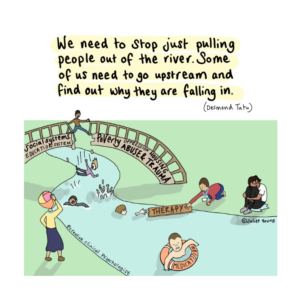
But it made me think: I would love to try my best to be a small part of solving the larger problem – of asking, why do people fall into the river in the first place? Why are some people more likely than others to be pushed? And how can we build better bridges so people fall less, or remove the triggers that push them? I want to be a part of prevention, not just treatment.
For instance, yes, to help the person who has been sexually abused. But why is that sexual abuse happening and what can we do to stop it? Not only helping to treat the victims, but stopping the perpetrators in the first place from committing these acts.
What do you think?
References
Johnstone, L., Boyle. (2020). A Straight Talking Introduction to the Power Threat Meaning Framework: An Alternative to Psychiatric Diagnosis. BPS Books.
Young, J. (2026). We need to stop just pulling people out of the river. Some of us need to go upstream and ask why they are falling in. [Illustration]. Juliet Young. https://www.julietyoung.co.uk/illustrations